
AlphaFold And The Quiet Revolution Happening Inside Every Cell
A decades-old biology problem was reframed as a prediction problem — and the answer was handed to researchers everywhere, free.
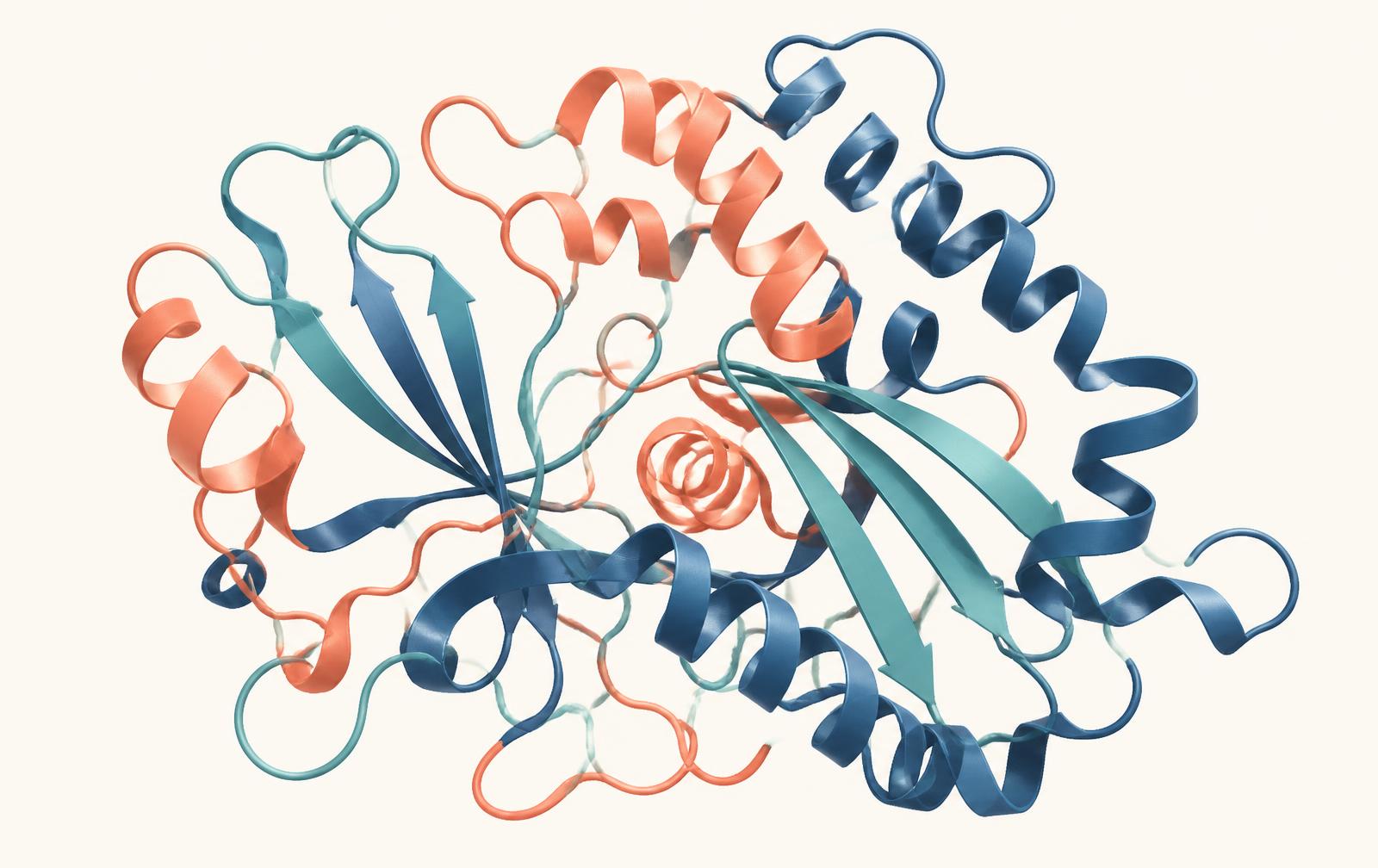
Some technology arrives with a launch event. Some arrives as a database that changes what thousands of laboratories can attempt before lunch. AlphaFold belongs to the second category.
The problem, briefly
Proteins do almost everything in a living cell, and what a protein does depends on the shape it folds into. Working out that shape experimentally — by crystallography, by cryo-electron microscopy — is precise, slow and expensive. For decades, predicting a structure from its amino-acid sequence alone was one of biology's most stubborn open problems.
The turn
AlphaFold, developed at DeepMind, treated folding as a machine-learning prediction task and reached an accuracy that the field's own long-running assessment exercise judged comparable, for many targets, to experimental results. The system's authors then did the thing that mattered most: they released predictions at scale. The AlphaFold Protein Structure Database, built with EMBL's European Bioinformatics Institute, made hundreds of millions of predicted structures openly available to any researcher with a browser.
In 2024 the Nobel Prize in Chemistry recognised work on protein structure prediction and design, shared by Demis Hassabis and John Jumper of DeepMind alongside David Baker.
The breakthrough was not only the model. It was the decision to give the output away.
What it changed in practice
- **Speed of the first question.** A structural hypothesis that once took months now takes minutes, which changes which experiments are worth designing at all.
- **Access.** A lab without a synchrotron or a cryo-EM facility can now start from a credible model. That shifts opportunity towards smaller and less well-funded institutions.
- **Neglected biology.** Researchers working on organisms and diseases that attract little commercial funding gained structural information they were unlikely ever to have generated themselves.
The honest limits
Predictions are predictions. A confident model of a single folded chain is not the same as knowing how a protein behaves in a crowded cell, how it flexes, how it binds a partner, or how a small molecule will sit in its pocket. Disordered regions, large assemblies and dynamic behaviour remain hard. Experimental structural biology has not been replaced; it has been re-pointed at the questions models cannot yet answer.
There is also a scientific-culture point worth noting. Tools this good encourage everyone to ask the same easy questions. The interesting work stays where it always was — in the design of the experiment that follows.
Why it is a Beaux story
Because the shape of the thing is optimism about how science can be done. A hard problem, a genuinely new method, and then the result released openly instead of locked behind a licence. That combination is rarer than it should be, and it is worth pointing at when it happens.
Have a Beaux Day.
- ai
- science
- biology
- open data
- research