The Frog That Came Back To Yosemite Valley
California red-legged frogs vanished from Yosemite Valley for decades. A long, patient reintroduction has them breeding there again.
Conservation wins rarely look like rescues. They look like paperwork, buckets and fifteen years of somebody checking a pond.
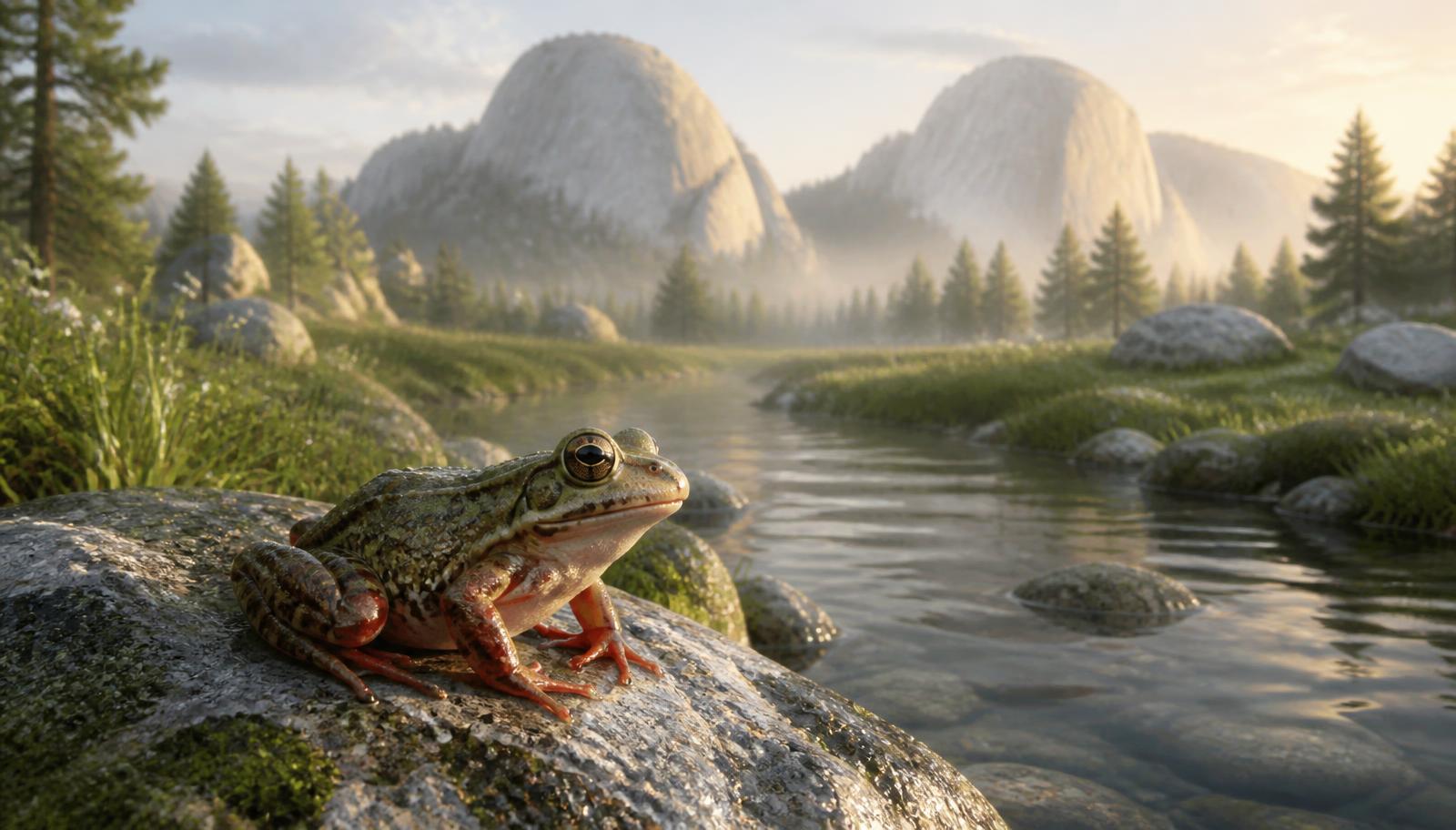
The California red-legged frog — the state's largest native frog, and a federally threatened species — disappeared from Yosemite Valley in the twentieth century. It is now breeding there again, the result of a reintroduction effort run over years by the National Park Service with partners including the San Francisco Zoo and the US Geological Survey.
Why it left
The California red-legged frog once ranged widely across the state and has lost a large majority of its historic range. In Yosemite Valley the causes were the familiar stack: habitat alteration, disease pressure, and above all non-native predators — introduced bullfrogs and predatory fish, which eat eggs, tadpoles and young frogs and out-compete natives in still water.
Mark Twain's celebrated jumping frog story is generally associated with this species, which is a decent measure of how embedded it once was in California's idea of itself.
How you put a frog back
Not by releasing adults and hoping. The method was incremental and heavily monitored.
Egg masses and tadpoles were collected from a source population in the Sierra foothills, reared in protected conditions — including at the San Francisco Zoo — and released into suitable Yosemite Valley habitat in stages, with the released animals tracked over subsequent seasons.
Before any of that could work, the habitat had to be made survivable. Non-native bullfrog and predatory fish removal in the target ponds was the precondition; without it, a reintroduction is a feeding programme.
The measure of success is not the release. It is the second generation. Frogs breeding in the valley on their own, producing egg masses in situ, is the point at which a reintroduction becomes a population.
What it took, and what it says
The honest headline here is duration. This was a multi-year, multi-agency effort with captive rearing, predator removal, staged releases and monitoring across more than a decade — the kind of work that produces no news for years and then produces a self-sustaining species.
It also demonstrates something useful about high-visibility places. Yosemite Valley is one of the most visited landscapes in the United States, photographed relentlessly, walked by millions. A native amphibian was absent from it for decades and most visitors would not have known. Recovery in a famous place is not automatic; it is deliberate, and it is possible.
If you go looking
You probably will not see one, and that is fine. Red-legged frogs are secretive, mostly nocturnal and concentrated in specific still-water habitat. The species is federally threatened, so handling, collecting or disturbing them or their egg masses is prohibited.
The visitor's job is simpler than that: stay on trails near wetland margins, never move water, fish, plants or amphibians between water bodies, clean boots and gear, and do not release anything into a pond, ever. Non-native predators arriving in a bucket is precisely how the frogs were lost.
Consider instead that somewhere in the valley, in shallow water under granite that gets photographed a thousand times a day, there is a frog laying eggs where its species had not laid eggs in living memory. Nobody will photograph that. It is still the better story.
Have a Beaux day.
- yosemite
- conservation
- amphibians
- california
- rewilding