
The Gulf Coast Got Its Train Back — And Kept It
Passenger rail vanished from the Mississippi and Alabama coast after Hurricane Katrina. It returned in August 2025. A year on, the route is still running.
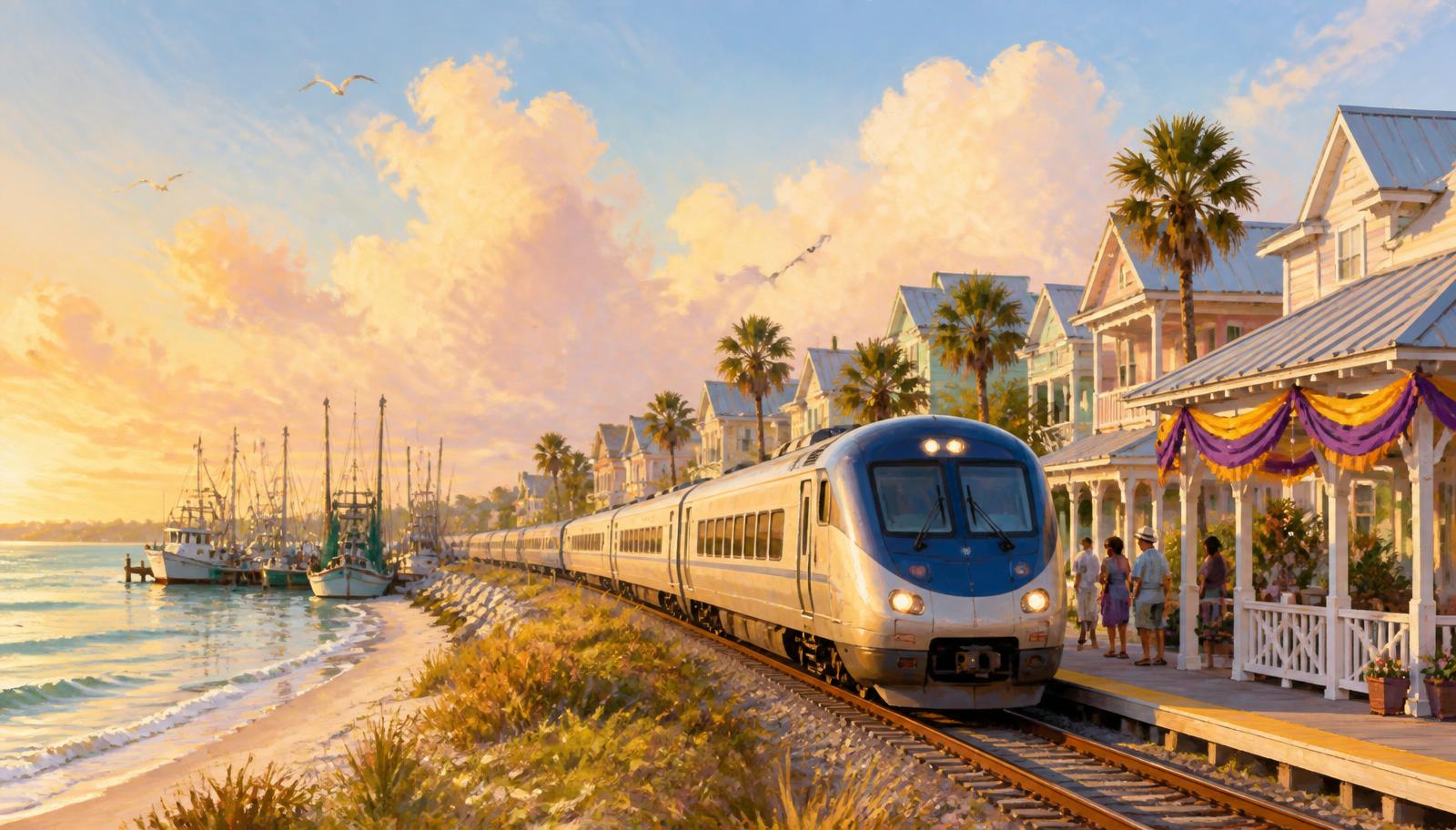
Restored train services have a habit of arriving to applause and leaving quietly. This one did not.
The Mardi Gras Service began operating on 18 August 2025, reconnecting New Orleans, Louisiana with Mobile, Alabama and running twice daily in each direction. It was the first scheduled passenger rail on that stretch of Gulf Coast in roughly two decades — service had ceased in the aftermath of Hurricane Katrina in 2005.
As of this month, it has completed its first full year.
What the route actually is
The train is short by American intercity standards, which is part of its appeal. Between the two endpoints it calls at four Mississippi coastal stops: Bay St. Louis, Gulfport, Biloxi and Pascagoula. End to end it is scheduled at about four hours.
Amtrak lists introductory one-way fares from $15, with the usual caveat that the cheapest buckets sell first. Bicycles are carried on board — a genuinely useful detail on a coast where the distance between a station and the water is often walkable but the distance between towns is not.
The naming is regional rather than promotional: Mardi Gras is the Gulf Coast's defining shared celebration, and Mobile's claim to the oldest organised Carnival tradition in the United States is a point of local pride.
Why it took twenty years
Because trains are not the hard part. Track access is.
The corridor is freight-owned working railroad, and restoring passenger service required agreement about capacity, dispatching and infrastructure upgrades alongside federal and state funding and coordination between two states and multiple municipalities. That is a slow, unglamorous negotiation involving no ribbon-cutting until the very end. Twenty years is not evidence of indifference so much as evidence of how much has to align.
The first-year test
The interesting question was never whether the launch would be celebrated. It was whether anyone would still be riding in the second, third and twelfth month, once novelty wore off and the route had to compete with a car.
A full year of continuous twice-daily operation is a meaningful answer in itself. Beyond that, we would rather be honest than impressive: we could not verify official first-year ridership totals, on-time performance figures or any confirmed plan to extend the service further along the coast. Numbers circulating without an Amtrak or state DOT source attached should be treated as estimates.
What it changes on the ground
For the coastal towns, a station is a different proposition from a highway exit. Bay St. Louis, Gulfport, Biloxi and Pascagoula are now reachable without a car from two cities with airports, which alters who can visit — students, older travellers, people who do not drive, day-trippers unwilling to hire a vehicle for a weekend.
It also alters the shape of a trip. Four hours of coastline through a train window is a route, not a transfer. You can take a bicycle, get off in a town you had not planned to visit, and get back on later in the day because there is a second service.
There is a broader signal here for anyone who follows American passenger rail. Restoration is possible; it is simply slow, and it depends on institutions staying interested long after the press release. The Gulf Coast now has a working example, one year proven, running twice a day in both directions while nobody is watching.
Have a Beaux day.
- rail travel
- amtrak
- gulf coast
- mississippi
- alabama
- new orleans